Table of Contents
Eclipse Calvià Countdown: 5 Days to Totality Over Santa Ponsa
Five days. That's what stands between today, Friday 7 August, and the moment Calvià goes dark in daylight. The eclipse Calvià has been building towards all summer arrives next Wednesday, 12 August, and in the last 24 hours the Ajuntament has released the sharpest, most specific picture yet of what the day will actually look like on the ground: exact road closures, exact times, and a clear answer on where you will and will not be allowed to stand.
The Countdown So Far
Here is where things stand with five days on the clock. The Spanish central government has declared 12 August an event of "excepcional interés público" — a designation reserved for occasions of genuine national significance, and one that has pulled in coordination from the Govern de les Illes Balears, the Direcció General d'Emergències i Interior, and every affected ayuntamiento on the island, Calvià included. This is not a normal Wednesday with a nice sky show tacked on. It is being run as a full civil protection operation.
The reason for the scale of the response is simple: this is the first total solar eclipse visible from Spanish soil since 1905, and the next one will not arrive until 2053. For most residents of Calvià, and most visitors lucky enough to be here that evening, this is a once-in-a-lifetime sky. The council's own communications have been blunt about the scale of interest already building, with prime viewing spots along the coast filling up in conversation weeks before the date itself.
Thinking about buying or selling in Mallorca?
What changed most recently, in the last day or two, is precision. Earlier guidance talked about traffic measures in general terms. Now there's a published list of exactly which junctions close, at exactly what time, and exactly which viewpoints are off-limits entirely. That's the detail this countdown update is built around.
Timings: What You'll Actually See
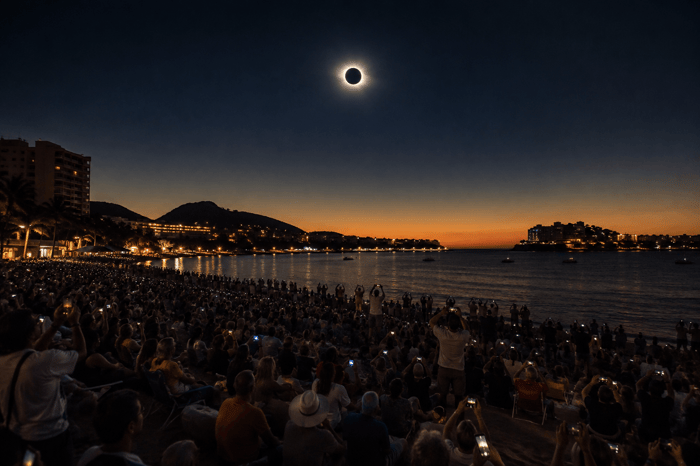
The partial phase begins at 19:38 local time, as the Moon starts its slow first bite out of the Sun low in the western sky. Totality itself arrives at approximately 20:31 and lasts around 1 minute 36 seconds — brief, but among the longer total phases anywhere along the eclipse's path across Spain. At that moment the Sun sits just 2.7 degrees above the horizon, which in practical terms means a clear run to the sea to the west is not optional. Anything solid between you and that horizon — a headland, a building, even a stand of trees — is enough to steal the view entirely.
This low geometry is precisely why the authorities are steering everyone so firmly towards specific, vetted locations rather than leaving people to find their own spot on the day. Sunset follows totality closely, so the whole sequence — partial phase, totality, and the Sun dropping below the horizon — plays out within roughly an hour, right at the golden end of the day.
Santa Ponsa's Official Observation Zone — and Where You Can't Go
Santa Ponsa beach has been formally designated Calvià's Official Observation Zone, one of 26 such zones spread across the Balearic Islands. It is the municipality's actively managed, marshalled answer to the question of where to watch, with capacity monitored throughout the day. Once the beach reaches its safe limit, access closes — arriving early is not just advisable, it is the only way to guarantee a place inside the official zone.
Elsewhere, the picture is more restrictive than many will assume. Access to Puig de sa Morisca is not permitted on the day, and neither is access to the municipality's principal viewpoints, including El Toro and the Illes Malgrats lookout. These are being closed outright as a precaution, since the paths and clifftop platforms in question were never built to hold eclipse-scale crowds safely. If your plan involved one of these elevated spots rather than the beach, it will not be possible — the alternative is Santa Ponsa itself, or one of the other official zones elsewhere on the island.
The Council's Traffic Plan: Every Closure Point
Calvià's special mobility and security operation activates from 15:00 on the day, well before the eclipse itself, and will scale up through the afternoon depending on how quickly crowds and traffic build. The council has been explicit that the operation may extend or tighten further if conditions demand it — so the following list is the current published plan, not a hard ceiling.
The confirmed restriction points are: Carretera de Cala Figuera at Rotonda 8, in the direction of Son Ferrer–El Toro; Plaça Jardí, at the junction of Carrer Jaume I, Avinguda de Santa Ponça and Carrer Bartomeu Rosselló Planas; the roundabout at Costa de la Calma, level with Bella Vista–Avinguda de la Mar; the access road to Portals Vells on the Carretera de Cala Figuera; both roundabouts at the entrance to El Toro, at Avinguda Neptuno and Avinguda Puig de sa Sírvia; and Avinguda Jaume I itself, from the Plaça Santa Ponça roundabout through to Carrer Lisboa, including the entrance and exit of the car park on Carrer Puig de Massanella.
Residents, guests staying at properties or hotels within the municipality, and anyone able to show a genuinely necessary journey will still be able to reach their destination, though checkpoints and delays are a normal part of the operation. The council's clearest single piece of advice is to avoid unnecessary car journeys altogether, particularly towards the coast and the viewpoints, and to use public transport wherever a trip is unavoidable.
How to Prepare Before Wednesday
ISO 12312-2 certified eclipse glasses remain essential for the entire partial phase — both before and after totality — with the sole exception of the roughly 96 seconds of totality itself, when it is safe to look directly at the eclipsed Sun with the naked eye. The moment any sliver of direct sunlight reappears, glasses need to go straight back on.
The Govern de les Illes Balears and AstroMallorca have built a free planning tool for exactly this kind of last-minute preparation: the Horitzó Eclipse 2026 app, available in Catalan, Spanish, English and German, and usable on any phone, tablet or computer as an installable web app. It lets you check the precise eclipse sequence for a specific spot before committing to it, which is worth doing between now and Tuesday if your viewing location isn't already locked in.
With five days left, the sensible order of operations is: pick your zone, check it in the app, sort your glasses, and plan to be in position well ahead of the 15:00 traffic measures rather than racing the clock on the day itself.
Why This Moment Matters for Calvià
It's worth stepping back from the logistics for a moment. A total solar eclipse over this stretch of coast is not a recurring feature of life in Calvià — it is a genuinely rare alignment that the municipality's current residents will very likely see only once. The last time it happened, in 1905, Santa Ponsa was a fishing hamlet rather than the town it is today. The next won't arrive until 2053, a lifetime away for most people reading this now.
For anyone who already knows this coastline through property in Santa Ponsa, or is simply spending the week here, 12 August is a genuinely rare reason to be on this particular stretch of coast at this particular hour. Five days out, the plan is set: the zone is Santa Ponsa beach, the time is 19:38 for first contact and 20:31 for totality, and the council's traffic operation begins at 15:00. The countdown from here is a short one.