Table of Contents
Mallorca vs the Costa del Sol: How Two Spanish Coasts Compare for Buyers
Ask a British or German buyer weighing up a Spanish coastal property and the shortlist almost always narrows to two names: Mallorca and the Costa del Sol. Both offer year-round sun, established international communities and direct flights from most of northern Europe. But the two markets are shaped by genuinely different geography, price structures and buyer profiles, and the choice between them usually comes down to what kind of property life you actually want.
What the Official Price Data Shows
Start with the numbers, because this is where the two regions diverge most clearly. According to the Colegio de Registradores, Spain's official land registrars' association, the Balearic Islands recorded an average residential price of 4,173 euros per square metre in the first quarter of 2026, the second-highest figure of any Spanish region after Madrid. Málaga province, which contains the Costa del Sol, came in at 3,339 euros per square metre over the same period. Both regions rank well above the Spanish national average, but Mallorca sits meaningfully higher, driven in large part by intense demand for southwest coastal property around areas like Santa Ponsa, Port d'Andratx and Bendinat.
Thinking about buying or selling in Mallorca?
That gap matters when you're setting a budget, but it doesn't automatically make the Costa del Sol the better-value option. Prices in both regions vary enormously by micro-location. A resale apartment inland in either region can cost a fraction of a beachfront villa in a prime coastal pocket, so regional averages are a starting point for planning, not a substitute for comparing specific areas against each other.
Geography and Feel
The most fundamental difference is that Mallorca is an island and the Costa del Sol is a stretch of mainland coast, and that shapes almost everything else. Mallorca offers a genuinely varied interior in a compact space: mountains, vineyards, historic inland towns and quiet countryside all within an hour's drive of the coast, alongside Palma, a proper working city with an airport, a cathedral and a full calendar of its own. The Costa del Sol runs along a longer, more continuous ribbon of coastline backed by the Sierra de Mijas and connected by road all the way to Málaga city and beyond, giving it a different kind of scale and connectivity, including easier onward travel by car to the rest of mainland Spain.
The Buyer Base
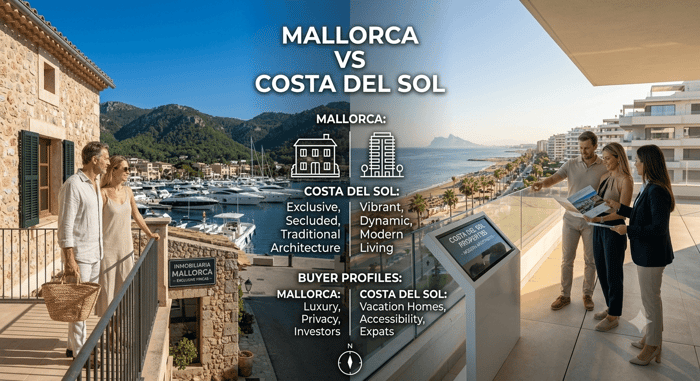
Both coasts draw heavily on northern European buyers, but the mix differs. Mallorca's southwest has long attracted German buyers in particular, who according to industry figures still account for a substantial share of foreign purchases on the island, alongside British, Scandinavian and increasingly American buyers drawn to the luxury end of the market. The Costa del Sol has historically leaned more heavily British and Scandinavian, with Marbella anchoring a well-established luxury segment of its own. Neither coast is exclusively any one nationality at this point, but the character of each market has been shaped by decades of that demand.
Access and Connectivity
Both regions are well served by international flights, with Palma and Málaga airports each handling large volumes of northern European traffic, particularly through the spring and summer months. Mallorca's compact size means most of the island, including the southwest, sits within a 30 to 45 minute drive of Palma airport. The Costa del Sol's greater length means travel times to Málaga airport vary more depending on where along the coast you're looking, from close to the airport around Marbella to considerably further towards Estepona or beyond.
Which Coast Fits You
Neither market is objectively better. Buyers drawn to Mallorca tend to want the combination of coast and genuine island character in one place: beach clubs and marinas alongside mountain villages and vineyards, all reachable without a long drive. Buyers drawn to the Costa del Sol often prioritise a longer, more built-out coastal strip with strong golf and lifestyle infrastructure and easier mainland connectivity. If you're weighing the two seriously, the most useful next step is comparing specific neighbourhoods against each other rather than the regions as a whole, since the character and price of Santa Ponsa or Port d'Andratx has very little in common with an inland town an hour away, and the same is true along the Costa del Sol.