Table of Contents
Life After the Golden Visa: How Non-EU Buyers in Mallorca Are Adapting
For over a decade, Spain's Golden Visa was the route most commonly discussed by non-EU buyers looking at Mallorca: invest €500,000 or more in property, and residency followed. That route no longer exists. Organic Law 1/2025 closed the real estate investment pathway on 3 April 2025, ending new applications under the property-based scheme. Buyers who filed before that cutoff are still being processed under the old rules, and existing permit holders keep their status and can renew it, but anyone looking at property in Mallorca today for residency purposes is working with a different set of options.
What hasn't changed is more significant than what has: non-EU nationals can still buy property in Spain freely, without restriction, exactly as before. The change is narrower than it sounds — property ownership simply no longer comes bundled with a residence permit. For anyone still set on both a Mallorca home and Spanish residency, the two now have to be arranged separately.
What Actually Changed
The abolished route wasn't limited to real estate. Organic Law 1/2025 removed the entire investor-residence framework under the old Law 14/2013, which also covered residency through investment in Spanish company shares or funds (€1 million-plus), government bonds (€2 million-plus), bank deposits, and qualifying business projects. All of these routes are gone for new applicants. The Spanish government's stated reasoning centred on housing affordability, particularly the effect of investor demand on prices in major cities, rather than anything specific to the Balearics.
For buyers who already held a Golden Visa, or who filed an application before the 3 April 2025 cutoff, transitional protections apply. Existing permits continue to be renewable, and the government has confirmed that holding a Golden Visa doesn't in itself lapse because the wider scheme closed. Anyone in that position with a case that isn't entirely straightforward — a pending renewal, a change in personal circumstances, an investment sold below the original threshold — is generally advised to have their specific situation reviewed individually rather than assume the general rule applies without exception.
Thinking about buying or selling in Mallorca?
The Routes Buyers Are Using Instead
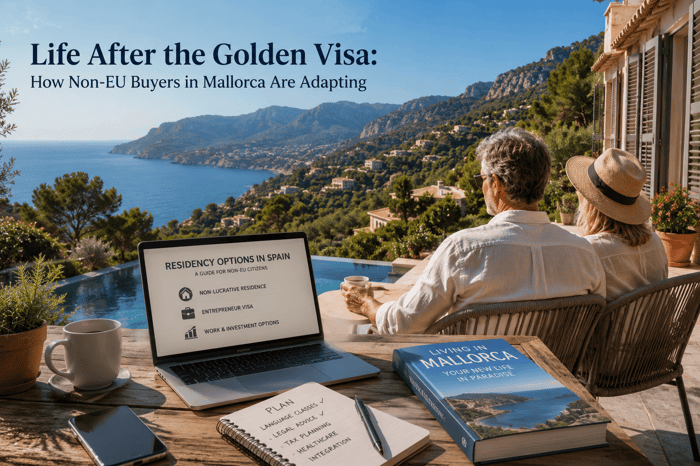
Non-EU buyers who still want to live in Spain, rather than simply own a holiday property here, are turning to a handful of established alternatives. The Non-Lucrative Visa suits people who can support themselves without working in Spain, though it comes with a genuine residency requirement — broadly, at least 183 days a year — which is a real shift for former Golden Visa holders who were often used to spending only a few weeks a year on the island. The Digital Nomad Visa fits remote workers employed by or contracting for companies outside Spain, with limits on how much income can come from Spanish clients. The Entrepreneur Visa is aimed at people setting up a genuinely new business in Spain rather than making a passive investment.
For highly qualified employees with a binding Spanish job offer, the EU Blue Card remains an option, requiring a recognised degree and a salary well above the Spanish average. None of these routes are a direct swap for the old property-investment model — each involves either an income or work requirement, a minimum-stay obligation, or both.
What This Means for Buyers Looking at Mallorca
Buying a property in Mallorca is, in itself, entirely unaffected. Non-EU nationals can purchase residential or commercial property here exactly as before, with no restriction tied to nationality or investment size. What buyers now need to separate clearly is the property decision from the residency decision — the first no longer automatically leads to the second.
For buyers who only ever wanted a holiday home and the ability to spend the Schengen-permitted 90 days in any 180-day period in Mallorca, the change makes little practical difference. For those who intended to relocate permanently, the shift means planning a residency route on its own terms — checking income thresholds, employment structure or business plans against the specific visa they're eligible for — well before, or independently of, any property purchase.
Getting the Right Advice
Because the residency landscape changed so significantly and so recently, buyers are generally better served working with an immigration lawyer alongside their property search rather than assuming last year's guidance still applies. Rules on income thresholds, the 183-day requirement for the Non-Lucrative Visa, and document validity windows are specific and change periodically, and getting them wrong at application stage can cost significant time.
What remains constant is that Mallorca's property market itself continues to function normally for international buyers, residency questions aside. For anyone exploring what's currently available across the island, browsing the full range of listings is a reasonable starting point while the residency side of the decision is worked out separately.