Table of Contents
Fuera de Ordenación in Mallorca: What an Irregular Planning Status Means for Buyers
Anyone who has looked at rustic properties in Mallorca has probably come across the phrase "fuera de ordenación" somewhere in the small print of a listing or a nota simple. It sounds alarming, and sometimes it should be treated with real caution, but it is also one of the most misunderstood terms in the Mallorcan property market. It does not automatically mean a property is illegal, unsafe, or unsellable. It means something more specific: part or all of the construction does not conform to the planning rules currently in force for that plot.
For buyers focused on the southwest of the island, where many of the most characterful fincas and country houses carry some form of extension, garage, or outbuilding added over the decades, understanding this status properly is essential before making an offer.
What Fuera de Ordenación Actually Means
A building is classed as fuera de ordenación when it exists legally on the ground, in the sense that the administration can no longer force its demolition, but it does not comply with the urban planning rules that apply to the land today. This typically happens because the construction predates the current planning rules, or because it was built without a licence at a point where the deadline for the town hall to act against it has since expired under Spanish administrative law.
The distinction matters. A building where the enforcement deadline has passed is in a different legal position from one that is still within the window where the town hall can order it torn down. Spanish law obliges the seller to disclose the planning situation of a property before a sale, and this disclosure is not optional small print. A buyer who later discovers an undisclosed fuera de ordenación situation has grounds to pursue compensation or contract rescission.
How a Property Ends Up in This Situation
In the Balearics, this status usually arises in one of two ways. The first is a change in planning law: a house or extension was built entirely legally under an older land classification, and a later reform of the planning rules for that zone left it out of step with the new criteria, even though nothing about the building itself changed. The second, more common in practice, is construction carried out without the correct licence on rustic land, often an extension to a finca, a pool, a garage, or an additional outbuilding that was never formally approved.
Thinking about buying or selling in Mallorca?
Both situations are widespread on rustic land across Mallorca, partly because rural building controls were applied inconsistently for long stretches of the twentieth century, and partly because many owners treated small extensions as private matters rather than administrative ones. Neither situation is unusual, and neither is automatically disqualifying for a buyer, but each carries different practical consequences that are worth understanding before signing anything.
What It Means for a Buyer
A fuera de ordenación classification restricts what can be done with the building going forward. Routine maintenance is generally permitted, but structural works, extensions, or a change of use typically require the building to be regularised first. The town hall will not issue new licences for further works on a construction it considers out of order, which is a common source of frustration for buyers who assume they can simply extend or upgrade a property after purchase.
There are also financing consequences. Spanish mortgage regulation excludes certain assets in this category from standard eligible collateral when the fuera de ordenación status is recorded at the Land Registry, which can complicate or block mortgage financing depending on the lender and the specific circumstances. A cash purchase avoids this obstacle, but a buyer relying on a mortgage should raise the question with their bank early, not after the arras contract is signed.
The Balearic Regularisation Route
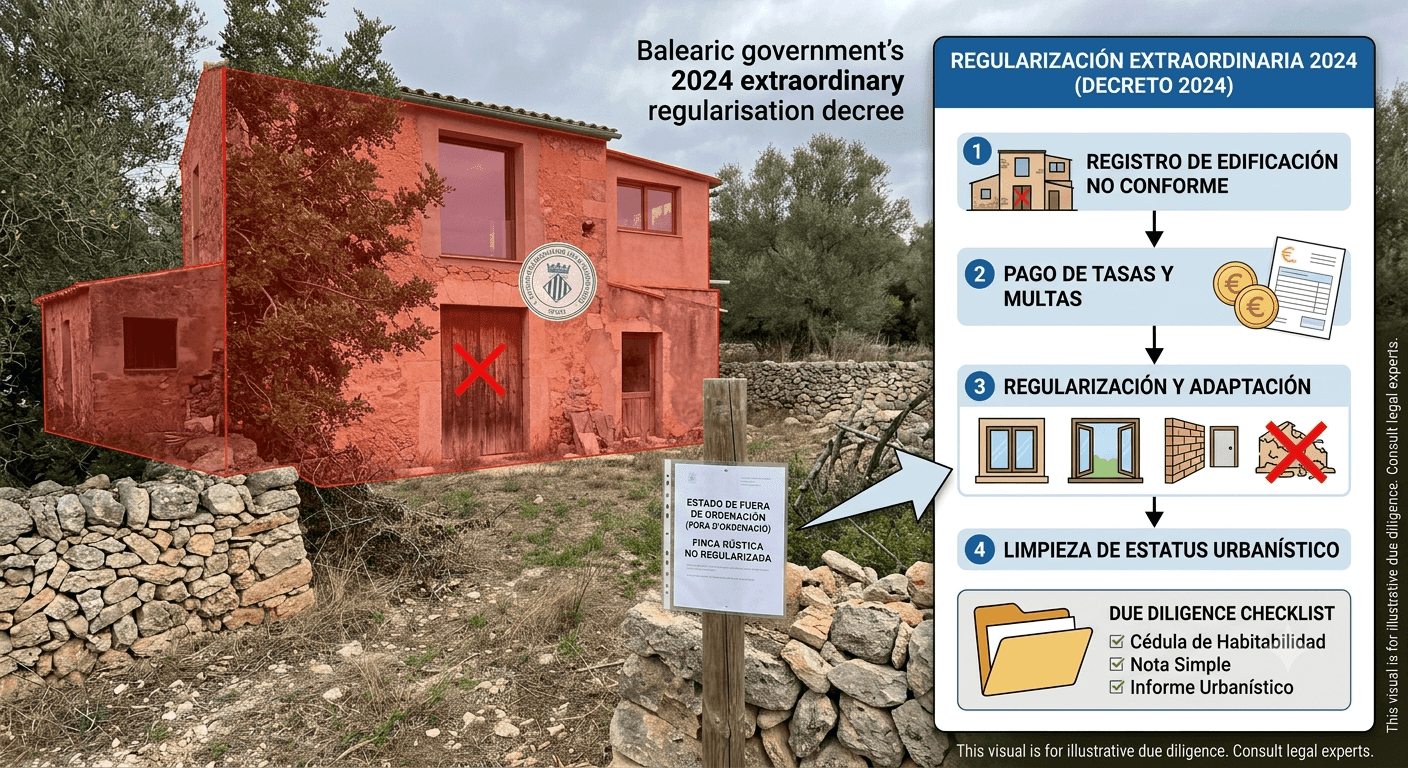
In May 2024, the Balearic Government approved a decree-law introducing an extraordinary route to regularise buildings, installations, and uses on rustic land that are fuera de ordenación and where the administration's power to order demolition has already expired by law. This is not an amnesty in the sense of erasing history. It is a formal legalisation procedure, with a filing window, technical requirements, and payments to be made.
Eligible constructions are generally those completed at least eight years before the decree entered into force, with earlier cut-off dates applying to land under stricter environmental protection. Certain categories are excluded outright, including buildings subject to demolition orders that predate the decree, constructions on public land or within coastal protection zones, and buildings intended for tourist accommodation, since the decree explicitly prohibits using a regularised construction for that purpose.
What the Regularisation Process Involves
Owners who use the extraordinary procedure pay a percentage of the construction's legalisation value on a staggered schedule, together with an accompanying technical project that brings the building up to current environmental and safety standards, covering matters such as reducing light pollution and improving water management. The process is administrative and can take time, so a buyer should not assume regularisation can be completed quickly or folded neatly into a purchase timeline.
For a buyer, the practical question is rarely whether to walk away from every fuera de ordenación property. Many long-established fincas in the southwest carry this status somewhere in their history, and the market has adapted around it. The practical question is whether the specific irregularity is disclosed, understood, and priced accordingly, and whether regularisation is realistic for that particular building given its location, age, and land classification.
What to Check Before You Buy
A lawyer acting for the buyer should request the nota simple from the Land Registry, check whether any fuera de ordenación annotation appears on the title, and cross-reference this against the town hall's urban planning file for the property. It is also worth asking directly whether any part of the building was constructed without a licence, since older extensions are sometimes never formally recorded even where the original main house is entirely regular.
Where a fuera de ordenación status is confirmed, the next question is whether the construction falls within the scope of the 2024 regularisation decree, and if so, what the estimated cost and timeline of that process would be. This is specialist territory, and the right professionals for this work are a local urbanismo lawyer and, where rustic land with agricultural or protected status is involved, a technical architect familiar with Balearic planning categories. Getting this assessment done before signing an arras contract, rather than after, is the single most useful piece of due diligence a buyer can do on an older Mallorcan property.