Table of Contents
- Sobrassada: The Sausage That Defines the Island
- Ensaimada: A Pastry With Centuries of History
- Tumbet: The Island's Most Honest Dish
- Pa Amb Oli: The Taste That Holds Everything Together
- Arros Brut: The Dish That Feeds the Community
- Where to Find These Foods
- Sobrassada: El Embutido Que Define La Isla
- Ensaimada: Un Dulce Con Siglos de Historia
- Tumbet: El Plato Mas Sincero de la Isla
- Pa Amb Oli: El Sabor Que Lo Une Todo
- Arros Brut: El Plato Que Alimenta a la Comunidad
- Donde Encontrar Estos Alimentos
- Sobrassada: Die Wurst, Die Die Insel Definiert
- Ensaimada: Ein Gebaeck Mit Jahrhundertelanger Geschichte
- Tumbet: Das Ehrlichste Gericht der Insel
- Pa Amb Oli: Der Geschmack, Der Alles Zusammenhaelt
- Arros Brut: Das Gericht, Das Die Gemeinschaft Naehrt
- Wo Man Diese Lebensmittel Findet
Sobrassada, Ensaimada, Tumbet: The Mallorcan Foods Every Resident and Visitor Should Know
One of the pleasures of spending real time on Mallorca, rather than simply passing through, is that you begin to understand the food. Not the tourist menus or the international restaurant scene that serves the island's busier months, but the actual, everyday food that Mallorcans have been eating for centuries: the dishes that appear on kitchen tables in farmhouses in the interior, at the market on a Saturday morning in Soller or Sineu, at the neighbourhood bar in a quiet street in Palma. This is food that has been shaped by every culture that has touched the island, from the Romans and the Arabs to the Christian Reconquest and the post-1492 arrival of ingredients from the Americas, and it is richer and more interesting than many visitors realise.
These are not dishes that require explanation on a menu. In the best sense, they are simply there, present in the texture of island life. But knowing a little of their history and character makes the experience of eating them here something more than lunch. It makes it a conversation with the island itself.
Sobrassada: The Sausage That Defines the Island
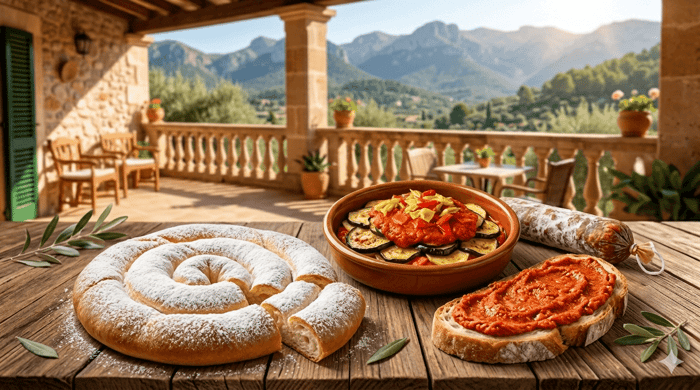
If you had to choose a single ingredient that most completely represents the character of Mallorcan food, it would be sobrassada. This soft, spreadable, deeply orange-red cured sausage, made primarily from ground pork, paprika and spices, is found everywhere on the island and used in almost everything. Smeared thickly onto a piece of rustic bread. Tucked into the filling of panades, the little circular pastries that are Mallorca's version of an empanada. Cooked into stews. Baked into ensaimada. Served alongside cheese and olives at the start of any serious meal.
Sobrassada has its origins in the medieval tradition of preserving pork through curing, a practice with roots in the Arab-influenced eastern Mediterranean. What makes Mallorcan sobrassada distinct is the combination of the island's specific humidity, which creates ideal curing conditions, and the incorporation of paprika from the Americas, which began in the seventeenth century and transformed the sausage into what it is today. The best versions are made from the meat of the Porc Negre, the native Mallorcan black pig, a breed that was once widespread across the island and has in recent decades been carefully revived by producers committed to quality. Sobrassada de Mallorca de Porc Negre carries a protected designation of origin under Decree 136/1993, meaning its production is regulated and its character is guaranteed.
The tradition behind sobrassada is also inseparable from the matanca, the communal pig slaughter that was for centuries one of the defining social rituals of Mallorcan rural life. Families and neighbours would gather to process an entire pig together across several days, the men responsible for the butchering and the women for cleaning the intestines and preparing the casings. Every part of the animal was used, and sobrassada was one of the primary results. The matanca was as much a celebration as a practical necessity, and its spirit lives on in the pride that producers and home cooks still take in a properly made sobrassada.
When buying sobrassada, you will encounter two main categories: the firmer, more intensely cured type that slices, and the softer, more spreadable version that comes in a wide range of curing times and intensities. The version made from Porc Negre tends to have a deeper, more complex flavour and a darker colour than the standard version. Both are available at any good market or delicatessen on the island.
Ensaimada: A Pastry With Centuries of History
The ensaimada is arguably the most famous thing to come out of Mallorca's bakeries, and if you have spent any time on the island you will know it immediately: the large spiral pastry dusted with icing sugar, its layers light and tender, sold in circular boxes that make it the classic souvenir to carry home. But the ensaimada is far more than a souvenir. It is a genuine piece of the island's identity, with written references dating back to the seventeenth century, when it was made for festivals and celebrations.
The name comes from the Catalan word saim, meaning rendered pork lard, which is the ingredient that gives the dough its characteristic texture. The most traditional version, the llisa, is plain, relying entirely on the quality of the dough and the lard. Others are filled: cabell d'angel is filled with the sweet orange threads made from pumpkin cooked slowly with sugar; cream versions are rich and indulgent; and there is the much-loved combination of sobrassada and pumpkin, which bridges the sweet and savoury in a way that is entirely Mallorcan.
The best ensaimadas are made daily by the island's specialist pastry shops and bakeries, and are at their finest when eaten on the day. In Palma, Fornet de la Soca on Carrer Vent is widely regarded as one of the finest producers, committed to using local and organic ingredients in the traditional recipes.
Tumbet: The Island's Most Honest Dish
Tumbet, also written as tombet, is one of those dishes that seems simple until you eat a truly good one, at which point it becomes something close to revelatory. At its heart, it is a baked, layered construction of aubergine, potato and red pepper, all fried separately in good olive oil and then arranged in layers in a clay pot, covered with a rich tomato sauce made with garlic and fresh tomatoes, and baked slowly until everything melds together.
What makes tumbet interesting, beyond its flavour, is its history. Despite feeling like one of the most quintessentially Mediterranean dishes imaginable, tumbet as we know it could not have existed before the sixteenth century. Tomatoes, potatoes and peppers all arrived in Europe from the Americas after 1492, and without them the dish would have no colour, no acidity and no sweetness. Tumbet is, in this sense, a dish that embodies globalism disguised as ancient tradition. Celler Sa Premsa in Palma, at Placa del Bisbe Berenguer de Palau 8, is one of the long-established addresses that serves it properly.
Pa Amb Oli: The Taste That Holds Everything Together
No account of Mallorcan food is complete without pa amb oli, and in some ways it is the most important dish of all, because it is the one that most completely captures the spirit of Mallorcan eating. Pa amb oli means bread with oil, but its full expression involves a piece of dense, rustic bread rubbed vigorously with the cut face of a ripe tomato until the juice and seeds are absorbed into the crumb, then drizzled with the best local olive oil and finished with a pinch of sea salt. It is then typically topped with anything that happens to be good: sobrassada, local cheese, a slice of Iberian ham, olives or anchovies.
Pa amb oli is simultaneously the most basic and the most revealing thing you can eat on the island, because its quality depends entirely on the ingredients. Mallorca produces some excellent olive oil, particularly from the ancient groves in the Tramuntana foothills and the areas around Soller and Valldemossa, and a properly made pa amb oli with a glass of local wine on a warm evening is one of the simple pleasures that makes life on this island feel fundamentally worthwhile.
Arros Brut: The Dish That Feeds the Community
Arros brut, which translates literally as dirty rice, is one of Mallorca's great communal dishes: a deep, slow-cooked stew of rice, meat, vegetables and spices. The ingredients vary by family and by season, but the base is typically a rich broth from pork, chicken or rabbit, often with sobrassada adding depth, and seasonal vegetables. Saffron, paprika, cinnamon and pepper are common spices. The rice is added towards the end and absorbs all the flavours around it. This is food made to be shared, and if you find it on a menu at a traditional Mallorcan restaurant, order it without hesitation.
Where to Find These Foods
The best place to encounter Mallorcan food in its most honest form is the island's traditional markets. The market in Sineu, held every Wednesday morning, is one of the most authentic on the island with an excellent selection of local produce, charcuterie and artisan products. The Mercat de l'Olivar in Palma, open daily, is the city's finest food market and an outstanding place to buy sobrassada, ensaimada, local cheeses and fresh vegetables. In Soller, the Saturday market around the main square is well-stocked with local citrus, olive oil and seasonal produce from the valley.
For eating out, Mallorca has a range of traditional celler restaurants that are among the most enjoyable dining experiences the island offers: unpretentious, often large places serving classic Mallorcan food at honest prices. Good food is one of the great daily pleasures of life in Mallorca, and it is entirely accessible. The island feeds its residents and guests generously, honestly and with a distinctly Mallorcan character that has been centuries in the making.
Sobrassada, Ensaimada, Tumbet: Los Alimentos Mallorquines Que Todo Residente y Visitante Debe Conocer
Uno de los placeres de pasar tiempo real en Mallorca es que poco a poco empiezas a entender la comida. No los menus turisticos ni la escena de restaurantes internacionales, sino la comida real y cotidiana que los mallorquines han estado comiendo durante siglos. Esta es una cocina moldeada por cada cultura que ha tocado la isla, desde los romanos y los arabes hasta la Reconquista cristiana y la llegada tras 1492 de ingredientes procedentes de las Americas, y es mas rica e interesante de lo que muchos visitantes imaginan.
Sobrassada: El Embutido Que Define La Isla
Si hubiera que elegir un solo ingrediente que represente de la manera mas completa el caracter de la cocina mallorquina, seria la sobrassada. Este embutido curado, suave y untable, de un intenso rojo anaranjado, se encuentra en todas partes y se utiliza en casi todo: en pan rustico, en panades, en guisos, en ensaimadas. Elaborada principalmente con carne de cerdo picada, paprika y especias, la sobrassada tiene sus origenes en la tradicion medieval de conservar carne mediante la curacion. La incorporacion del pimenton procedente de las Americas, que comenzo en el siglo XVII, la transformo en lo que conocemos hoy. La Sobrassada de Mallorca de Porc Negre, elaborada con el cerdo negro autoctono de la isla, cuenta con denominacion de origen especifica regulada por el Decreto 136/1993. La tradicion detras de la sobrassada es inseparable de la matanca, la matanza colectiva del cerdo que durante siglos fue uno de los rituales sociales mas importantes de la vida rural mallorquina.
Ensaimada: Un Dulce Con Siglos de Historia
La ensaimada es sin duda el producto mas famoso de las pastelerias de Mallorca: el gran pastel en espiral espolvoreado con azucar glas, vendido en cajas circulares. Su nombre proviene del catalan saim, que significa manteca de cerdo, el ingrediente que confiere a la masa su textura caracteristica. Las referencias escritas se remontan al siglo XVII. La version mas tradicional, la llisa, es sencilla y depende enteramente de la calidad de la masa. Otras estan rellenas: cabell d'angel con calabaza y azucar, crema, o la apreciada combinacion de sobrassada y calabaza que une lo dulce y lo salado. En Palma, Fornet de la Soca en el Carrer Vent esta reconocido como uno de los mejores productores.
Tumbet: El Plato Mas Sincero de la Isla
El tumbet es una construccion horneada en capas de berenjena, patata y pimiento rojo, todos fritos por separado en buen aceite de oliva, colocados en capas en una cazuela de barro y cubiertos con salsa de tomate casera. A pesar de parecer un plato quintaesencialmente mediterraneo, no podria haber existido antes del siglo XVI, ya que los tomates, las patatas y los pimientos llegaron de las Americas despues de 1492. El Celler Sa Premsa en Palma, en la Placa del Bisbe Berenguer de Palau 8, es una de las direcciones que lo sirve de la manera correcta.
Pa Amb Oli: El Sabor Que Lo Une Todo
El pa amb oli, pan frotado con tomate maduro, rociado con aceite de oliva local y terminado con sal marina, es la cosa mas basica y la mas reveladora que puedes comer en la isla. Su calidad depende enteramente de los ingredientes. Mallorca produce un aceite de oliva excelente, especialmente en los olivares de las estribaciones de la Tramuntana y en las zonas de Soller y Valldemossa.
Arros Brut: El Plato Que Alimenta a la Comunidad
El arros brut es un estofado profundo y cocinado lentamente de arroz, carne, verduras y especias. La base es tipicamente un caldo rico con cerdo, pollo o conejo, a menudo con sobrassada que aporta profundidad. Es comida hecha para compartir, tipica de los almuerzos familiares del domingo en el interior de Mallorca.
Donde Encontrar Estos Alimentos
El mercado de Sineu, que se celebra cada miercoles por la manana, es uno de los mas autenticos de la isla. El Mercat de l'Olivar en Palma, abierto a diario, es el mejor mercado de alimentacion de la ciudad. En Soller, el mercado del sabado esta bien surtido de citricos locales, aceite de oliva y productos de temporada. La buena comida es uno de los grandes placeres cotidianos de la vida en Mallorca, accesible y llena de caracter.
Sobrassada, Ensaimada, Tumbet: Die Mallorquinischen Lebensmittel, Die Jeder Kennen Sollte
Eines der Vergnuegen beim echten Verweilen auf Mallorca ist das Verstaendnis fuer die Kueche. Nicht die Touristenmenues, sondern das echte, alltaegliche Essen, das die Mallorcaner seit Jahrhunderten auf den Tisch bringen. Diese Kueche wurde von jeder Kultur gepraeagt, die die Insel beruehrt hat, von den Roemern und den Arabern bis zur Reconquista und der nach 1492 eintreffenden Zutaten aus den Amerikas.
Sobrassada: Die Wurst, Die Die Insel Definiert
Sobrassada ist eine weiche, streichbare, tief orangerote Dauerwurst aus gemahlenem Schweinefleisch, Paprika und Gewuerzen. Sie ist ueberall auf der Insel zu finden und wird in fast allem verwendet. Ihre Urspruenge liegen in der mittelalterlichen Tradition der Schweinefleischkonservierung. Die Zugabe von Paprika aus den Amerikas im 17. Jahrhundert verwandelte die Wurst in das, was sie heute ist. Sobrassada de Mallorca de Porc Negre traegt eine gestuetzte Ursprungsbezeichnung gemaess Dekret 136/1993. Die Tradition ist untrennbar mit der Matanca verbunden, der gemeinschaftlichen Schlachtung, bei der Familien und Nachbarn zusammenkamen, um gemeinsam ein Schwein zu verarbeiten.
Ensaimada: Ein Gebaeck Mit Jahrhundertelanger Geschichte
Die Ensaimada ist das beruhmteste Produkt aus Mallorcas Backstuben: das grosse Spiralgebaeck, mit Puderzucker bestaubt, in runden Schachteln verkauft. Der Name stammt vom katalanischen Saim (Schweineschmalz). Schriftliche Belege reichen bis ins 17. Jahrhundert zurueck. Die traditionellste Version, die Llisa, ist schlicht. Andere sind gefuellt: Cabell d'Angel mit Kuerbis und Zucker, Creme oder die beliebte Kombination aus Sobrassada und Kuerbis. In Palma gilt Fornet de la Soca in der Carrer Vent als einer der besten Hersteller.
Tumbet: Das Ehrlichste Gericht der Insel
Tumbet ist ein gebackenes, geschichtetes Gericht aus Aubergine, Kartoffel und roter Paprika, alle separat in gutem Olivenoel gebraten und in einem Tontopf mit hausgemachter Tomatensauce ueberbacken. Trotz seines mediterranen Charakters konnte es vor dem 16. Jahrhundert nicht existieren, da Tomaten, Kartoffeln und Paprika erst nach 1492 aus den Amerikas kamen. Celler Sa Premsa in Palma, Placa del Bisbe Berenguer de Palau 8, serviert es auf die richtige Art.
Pa Amb Oli: Der Geschmack, Der Alles Zusammenhaelt
Pa Amb Oli, rustikales Brot mit reifer Tomate eingerieben, mit lokalem Olivenoel betraenfelt und mit Meersalz abgeschlossen, ist sowohl das grundlegendste als auch das aufschluessreichste Essen auf der Insel. Mallorca produziert hervorragendes Olivenoel, besonders aus den uralten Hainen in den Tramuntana-Vorhuegelm und um Soller und Valldemossa.
Arros Brut: Das Gericht, Das Die Gemeinschaft Naehrt
Arros Brut ist ein tiefer, langsam geschmorter Eintopf aus Reis, Fleisch, Gemuese und Gewuerzen, typischerweise mit einer reichen Bruehe aus Schweinefleisch, Haehnchen oder Kaninchen. Es ist Essen, das zum Teilen gemacht wurde, typisch fuer mallorquinische Sonntagsmittag-Essen im Inselinneren.
Wo Man Diese Lebensmittel Findet
Der Markt in Sineu jeden Mittwochmorgen ist einer der authentischsten auf der Insel. Der Mercat de l'Olivar in Palma, taeglich geoeffnet, ist der feinste Lebensmittelmarkt der Stadt. In Soller ist der Samstagmarkt gut sortiert mit lokalem Zitrusobst, Olivenoel und Saisonprodukten. Gutes Essen ist eines der grossen alltaeglichen Vergnuegen des Lebens auf Mallorca und vollstaendig zugaenglich.