Table of Contents
Ses Salines: Mallorca's 2,400-Year-Old Salt Flats Still Worked by Hand
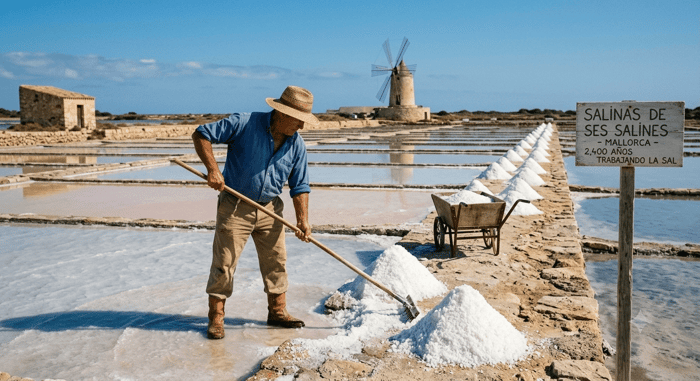
Drive south past Campos and the landscape flattens out into something you don't expect on Mallorca: mile after mile of shallow, geometric pools, some the colour of the sky, some blushed pink, edged by mountains of white crystal. This is Ses Salines, the salt flats that gave the southeastern municipality its name, and they've been worked continuously since Punic merchants first cut channels here around the 4th century BC. Roman traders later valued the salt so highly that it moved by ship across the Mediterranean. What's remarkable isn't just the age of the place. It's that the harvest still happens largely as it always did, and you can watch it.
A Living Industry, Not a Museum
Salines de Llevant, the company that now runs the works at Es Trenc, traces its formal roots to 1850, when salt extraction here was industrialised for the first time. But the underlying technique goes back millennia further, and much of it hasn't changed. Seawater is drawn in through a channel roughly two kilometres long, then guided through a sequence of shallow evaporation pools known locally as cuarteradas. The Mediterranean sun and the Tramuntana wind do the rest, concentrating the brine until crystals form on the surface and settle on the pool floor.
Thinking about buying or selling in Mallorca?
Harvest comes in late summer, typically through September, when the water has evaporated enough to leave a thick crust behind. Workers still rake and gather much of it by hand, piling the wet salt into the pale, snow-like mountains that have become one of the most photographed sights on this stretch of coast. The finest, most delicate crystals are skimmed separately and sold as flor de sal d'Es Trenc, a gourmet product that now reaches kitchens well beyond the island.
Why the Flats Still Matter
Ses Salines produces somewhere in the region of ten to fifteen thousand tonnes of salt a year, a modest figure by industrial standards but enough to keep this one of the last working traditional salt operations in the Balearics. The flats sit inside the Parc Natural de Es Trenc-Salobrar de Campos, a protected wetland that draws flamingos, herons and migrating waders drawn to the shallow, mineral-rich water. Birdwatchers regularly spot species that stop here on the long crossing between Africa and continental Europe, which means the salt pans do double duty: an economic asset and a functioning ecosystem in one.
The archaeology backs up the deep history too. Nearby, the Talaiotic settlement of Els Antigors and structures such as Talaia Joana point to Bronze Age communities who understood the value of this coastline long before the Romans arrived. Ses Salines only became an independent municipality, separating from neighbouring Santanyí, just over a century ago in 1925, but the place itself has been shaping how people live and trade here for far longer.
Visiting the Salt Flats
You don't need a guided tour to appreciate Ses Salines, though a stop at the small salt shop near the works is worth it if you want to bring home a bag of flor de sal. The flats sit a short drive from Es Trenc beach and Colonia de Sant Jordi, so most visitors fold in a swim or a seafood lunch alongside the visit. Early morning or late afternoon light is when the pools show their colour best, and September, harvest month, is when the white salt mountains are at their most dramatic.
The village of Ses Salines itself is worth a slower look too: a compact inland town of stone houses and a market on Thursdays, with none of the polish of the resort towns further north. It's the kind of place that rewards an afternoon spent wandering rather than ticking off a single sight.
The Southwest Connection
Ses Salines sits well outside Imperial Properties' core southwest patch around Santa Ponsa and Calvià, but it's exactly the kind of place that explains why people fall for Mallorca beyond the beach clubs and marinas. The island's appeal has always rested on this contrast: sophisticated coastal living in the southwest, paired with pockets of genuine, working history like this an hour's drive away. If you're weighing up where on the island to buy, it's worth seeing both sides before you decide.