Table of Contents
Ley de Costas: What Spain's Coastal Law Means When You Buy a Seafront Home in Mallorca
The Ley de Costas is Spain's coastal law. It makes the shoreline public and sets protection zones behind it, normally 100 metres, or 20 metres where land was already urban in 1988. Inside these zones, new homes are prohibited and works on existing ones are restricted.
For anyone buying a frontline villa or apartment in Mallorca, it is one of the most important pieces of law to understand. It decides what you own, what you can build, and who has the right to walk past your garden wall.
What the Ley de Costas Protects
The law in force is Law 22/1988 of 28 July, substantially reformed by Law 2/2013. It defines a band of public domain along the coast, the dominio público marítimo-terrestre, which includes the seashore zone reached by the biggest known storms, beaches and dunes, and steep cliffs in contact with the sea up to their top edge.
This public domain belongs to the State. It is inalienable, cannot be acquired by long use, and cannot be seized. The law also states that private holdings carry no weight against it, however long they have lasted and even when they appear in the Land Registry. In other words, if part of a plot falls within the public domain, a title deed does not change that.
Thinking about buying or selling in Mallorca?
The Zones Every Seafront Buyer Should Know
All the zones are measured inland from the inner limit of the seashore, the line fixed in the official boundary survey, known as the deslinde.
- Transit easement (servidumbre de tránsito): a strip of 6 metres that must be kept permanently clear for pedestrians and for surveillance and rescue vehicles. In difficult or dangerous places it can be widened to a maximum of 20 metres.
- Protection easement (servidumbre de protección): 100 metres as a general rule, which the State can extend by up to another 100 metres where a stretch of coast needs it. Where land was already classified as urban when the law came into force in 1988, the protection zone is 20 metres.
- The first 20 metres: within the first 20 metres of the protection zone, no fences or enclosures are allowed except under the conditions set by regulation.
- Zone of influence: at least 500 metres inland, where planning must avoid walls of buildings and excessive concentrations of volume along the coast.
The difference between 20 and 100 metres is enormous for a seafront property, and it depends on the planning status of the land in 1988. It has to be checked plot by plot.
What You Can and Cannot Do in the Protection Zone
The protection zone is private land, and you can own a home within it. What the law restricts is what happens there. Article 25 prohibits, among other things:
- new buildings for residential use;
- overhead high-voltage power lines;
- dumping of rubble or untreated waste water;
- advertising through billboards or audiovisual means.
Crops and plantations are allowed without authorisation. Uses that by their nature cannot go anywhere else, services for the use of the beach, and uncovered sports facilities are allowed with the relevant authorisation.
For existing homes built legally before the law, the rules are more practical than many buyers fear. Repairs and improvements are allowed as long as they do not increase the volume of the building. Where a revised boundary survey brings an existing building into the protection zone, the 2013 reform allows repair, improvement, consolidation and modernisation works, provided they do not increase volume, height or floor area, and they have to improve the building's energy efficiency.
Buildings that sit within the 6-metre transit strip are in a weaker position, as the law treats them as out of planning compliance. If that applies to a property you are considering, our guide to fuera de ordenación explains what that status means.
The Deslinde and the Land Registry
The State draws the boundary of the public domain through the deslinde procedure. When a deslinde is opened, the Land Registry records a marginal note on the affected properties, warning that the procedure can bring them, in whole or in part, into the public domain or the protection zone. Once approved, the deslinde is enough to correct any registry entries that contradict it.
When a property in the protection zone is registered for the first time, its description has to say whether or not it borders the public domain. These details show up in the registry extract, which is why the nota simple is one of the first documents to review for any coastal purchase.
Public Access to the Sea
The law guarantees public access to the coast. In urban areas, planning has to provide road accesses to the sea no more than 500 metres apart and pedestrian accesses no more than 200 metres apart. No works may block an existing access unless an equivalent alternative is provided.
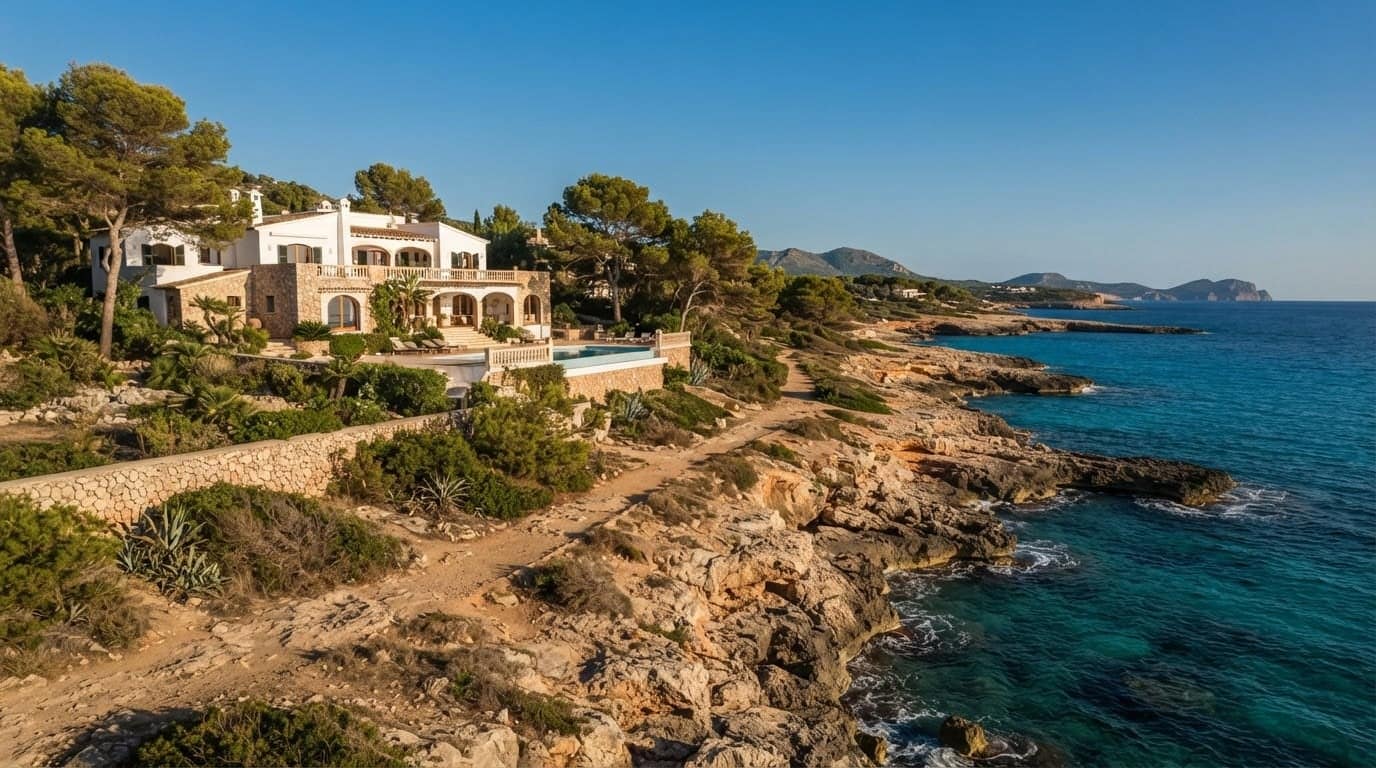
In practice, this is why so many of Mallorca's seafront homes look out over a public coastal path. For most owners it is simply part of the charm of living by the sea, but it is worth knowing before you buy.
Who Manages the Coast in the Balearics
Since 1 July 2023, the Balearic Government has managed a large part of coastal administration in the islands, including authorisations within the public domain and the transit strip. The State keeps key functions, among them setting fees for the use of the public domain and issuing mandatory reports. You can read the official announcement of the transfer from La Moncloa.
The full consolidated text of the law is published on the Boletín Oficial del Estado.
Checks Before You Buy a Seafront Property
- Confirm whether an approved deslinde exists for that stretch of coast and where the line runs in relation to the plot.
- Establish whether the protection zone is 20 or 100 metres on that plot.
- Check the nota simple for any marginal notes or references to the public domain.
- Make sure the existing building and any later extensions have the correct licences.
- If you plan to renovate, check with an architect what works the coastal rules allow before you sign.
An independent lawyer and a local architect who know the coast are worth every euro on a frontline purchase. Getting the facts right at the start protects both the purchase and its future resale value.
Seafront Homes with Imperial Properties
Imperial Properties has been helping buyers find homes on Mallorca's southwest coast since 1985, and we work in English, German and Spanish. Browse our latest properties for sale across Mallorca.
Call us on +34 971 692 434, message us on WhatsApp, or email help@imperial-properties.com. If you are thinking of selling, you can request a free property valuation.