Table of Contents
Berths at Port Adriano and Puerto Portals: What It Actually Takes to Moor in the Southwest
Anyone who has walked the pontoons at Port Adriano or Puerto Portals in August has seen how tightly packed the southwest's two marquee marinas are. Both are regularly described as having long waiting lists, but neither publishes official queue data the way Mallorca's public ports do. Here is what can actually be verified about getting a berth at either marina, and how that differs from the smaller public ports along the coast.
It matters because the two systems work quite differently, and confusing them leads to a lot of the vague "years-long waiting list" claims that circulate about Mallorca's marinas.
Thinking about buying or selling in Mallorca?
Public Ports vs. Private Concessions
Ports IB, the Balearic government's port authority, manages a network of public marinas around the islands — places like Porto Cristo, Cala Figuera and Portopetro — and publishes berth availability and application information for those ports directly, since they are run as a public service with berths allocated by rules the authority sets. Port Adriano and Puerto Portals are a different model entirely: both operate under long-term concessions granted by the Balearic government to private operating companies, which then run the marina commercially, set their own berthing terms, and decide who gets a berth and on what basis. There is no equivalent public waiting-list register for either of them, which is why official queue-length figures for these two marinas do not exist to cite.
Port Adriano: Scale and Character
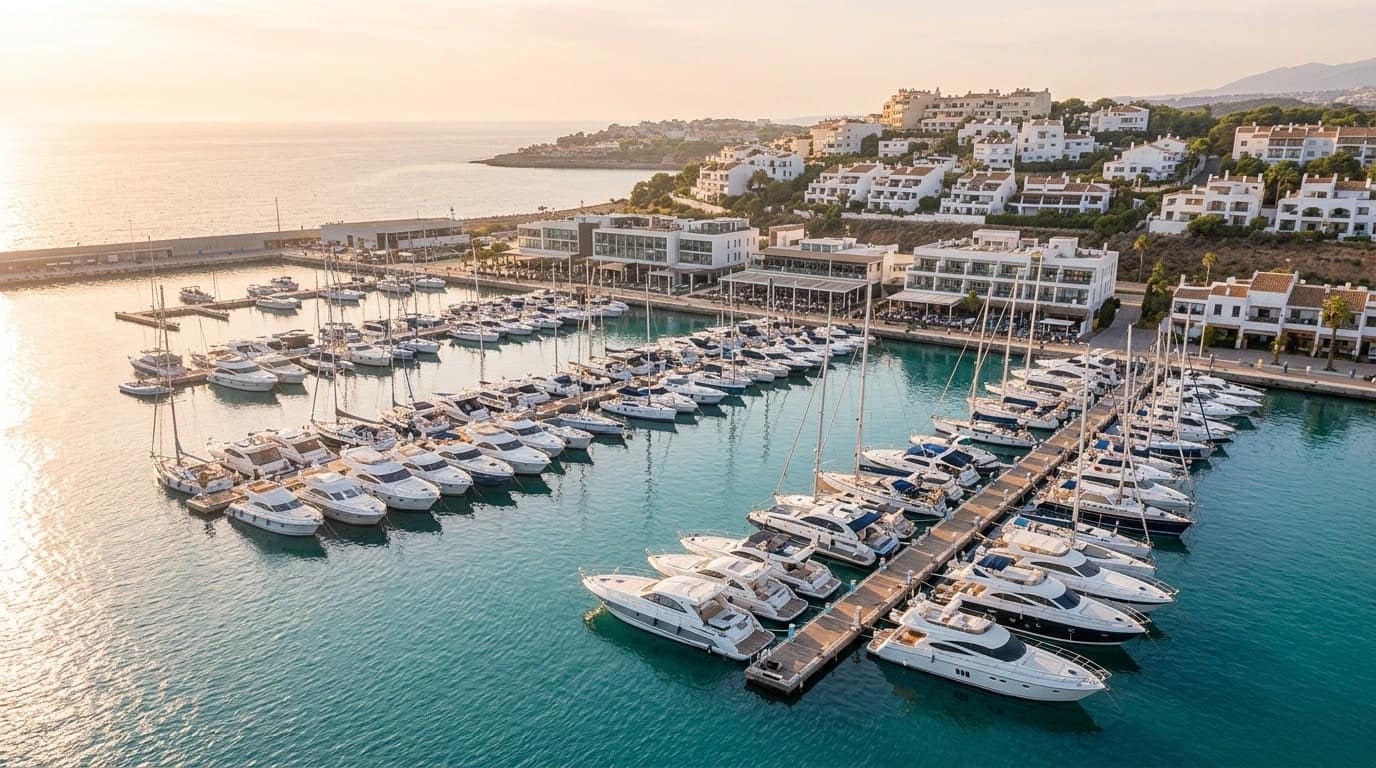
Port Adriano, on the coast at El Toro between Santa Ponsa and Portals, was redeveloped under a design associated with Philippe Starck and has positioned itself firmly at the superyacht end of the market, with berths built out to accommodate very large vessels alongside a marina village of restaurants, boutiques and a beach club. Its scale and design brief make it one of the two most sought-after addresses on this coast for larger craft, alongside Puerto Portals itself.
Puerto Portals: Scale and Character
Puerto Portals, a few kilometres along the coast near Calvià, has been established for longer and built its reputation as one of the Mediterranean's original glamour marinas from the 1980s onward, with a similar mix of high-end retail, restaurants and berths ranging from standard leisure craft up to superyacht moorings. Both marinas draw the same pool of owners and brokers, which is part of why availability at either is genuinely tight in peak months.
The Concession Fee: What Operators Pay the Govern
Because both marinas sit on public maritime domain, the private companies operating them pay a concession fee — a canon — to the Balearic government for the right to run the port commercially over the life of the concession. This is a matter of public administrative record in principle, agreed as part of each concession contract, but the current specific canon figures for either marina are not published in a form that can be verified and cited reliably here, so this article does not put a number on it. What matters for a prospective berth-holder is simply that the fee structure is between the operator and the Govern, not something paid directly by boat owners.
How Berths Are Actually Allocated
Since neither marina runs a public queue, a berth at Port Adriano or Puerto Portals is obtained in practice through the marina's own commercial office, directly or via a yacht brokerage that handles marina placements as part of its wider service. Long-term berth holders and superyacht-length spaces are the tightest category at both marinas, while shorter-term or transit berths for smaller leisure boats have more turnover, particularly outside the July-to-September peak. Anyone seriously exploring a berth at either marina is better served contacting the marina's own commercial team or a broker directly than relying on secondhand claims about queue length, precisely because there is no official list to check.
Market-Rate Pricing, Not Official Tariffs
Because these are commercially operated marinas rather than public ports with published tariff schedules, prices for a long-term berth are set by the operator and move with demand, which is itself shaped heavily by vessel length and the season. Brokerage listings and marina operators themselves are the only reliable source for current pricing, and any figure quoted should be treated as a snapshot of that moment's market rather than a fixed public tariff of the kind Ports IB publishes for its own network.
Public Ports as the Alternative
For owners of smaller leisure boats who do not need the profile or facilities of Port Adriano or Puerto Portals, the public ports in the Ports IB network remain the more transparent route, with published berth information and a formal application process run by the authority itself rather than a private operator. It is a genuinely different experience from mooring among the superyachts of the southwest's two flagship marinas, but for many boat owners it is the more straightforward one.