Table of Contents
Catastro vs Registro: Why Your Mallorca Property's Two Official Records Must Match
Catastro vs Registro comes down to this: the Catastro is the state's tax inventory describing where a property is, how big it is and what it is worth, while the Registro de la Propiedad records who legally owns it and what charges it carries. Before you buy, check both and check that they match.
Most buyers in Mallorca hear about the nota simple early on, and rightly so. Fewer realise that Spain keeps a second official record of every property, run by a different authority for a different purpose, and that the two do not always tell the same story. A villa can appear in the Catastro with a pool and an extension that the Registro has never heard of, or a plot can be measured one way in the deeds and another way on the cadastral map.
None of this is unusual, especially with older homes in the countryside or in the first urbanisations of the southwest. But it is far easier to deal with before you sign than after. Here is how the two systems work, why they differ and what to check.
What the Catastro Does
The Catastro Inmobiliario is a national administrative register that belongs to the Ministry of Finance, through the Dirección General del Catastro. Its job is to describe every property physically and economically: its location, the shape and size of the plot, the built area, the use and the construction details. Each property has a referencia catastral, a 20-character code that identifies it uniquely, and Spanish law requires that reference to appear in the deed when a property changes hands.
The Catastro also sets the valor catastral, the administrative value on which your town hall calculates the annual IBI and the municipal plusvalía when you sell. Since 2022 it also publishes a valor de referencia for each property, which works as the minimum taxable base for transfer tax when you buy. If you want to understand the IBI side in detail, our guide to the annual IBI property tax covers it.
Thinking about buying or selling in Mallorca?
Anyone can look up the non-protected data of a property, including its map, plot and built area, free on the Sede Electrónica del Catastro. Owners can access their full data and download certificates with a digital certificate or Cl@ve. What the Catastro does not do is prove ownership. It is a tax and mapping tool, not a title register.
What the Registro de la Propiedad Does
The Registro de la Propiedad is run by property registrars, legal professionals organised through the Colegio de Registradores. It records rights rather than physical facts: who owns the property, in what shares, and what mortgages, embargoes, easements or other charges affect it. Rights that are registered are protected against third parties, which is why banks and buyers rely on it.
The quickest way to see what the Registro says is a nota simple, an informative extract you can request online through registradores.org. The fee is 9.02 euros per property, excluding taxes, and it usually arrives by email. It shows the registered owner, the description of the finca, its registry number and the charges recorded against it. It also states the referencia catastral and whether the finca is graphically coordinated with the Catastro.
Why the Two Records Often Do Not Match
For most of their history the two systems grew up separately. The Registro describes a property using whatever the deeds presented to it said, sometimes decades ago, with boundaries described by neighbours or by old local measurements. The Catastro builds its description from surveys, aerial imagery and declarations, and it updates when it detects changes on the ground.
The result is a set of familiar mismatches. A porch, a guest annex or an extra floor added years ago appears in the Catastro but was never declared in a new deed, so the Registro still describes the original house. A plot is several hundred square metres larger or smaller in one record than in the other. A pool shows on the cadastral map but not in the registered description. Occasionally the referencia catastral attached to a registered finca is simply wrong.
The 2015 Reform and Coordination
Spain tried to bring the two together with Ley 13/2015, of 24 June, which reformed both the Mortgage Law and the Catastro law and came into force on 1 November 2015. It created procedures to coordinate the registered description with the cadastral map, using a georeferenced graphic representation of the plot, and it requires every piece of registry information to say whether the finca is coordinated with the Catastro at a given date.
Coordination is compulsory for certain operations, such as registering a property for the first time or splitting and merging plots, and it can also be requested voluntarily. In practice many existing homes in Mallorca are still not coordinated, which is not a problem in itself, but it means the buyer has to compare the two records and understand any difference.
What a Discrepancy Means in Practice
A difference between Catastro and Registro is a question to answer, not automatically a reason to walk away. The key is to find out why it exists. If the Catastro shows more built area than the Registro, there is an extension that was never declared in a deed, and the next question is whether it was built with a licence. If it was not, the planning position matters, which we explain in our article on fuera de ordenación status.
Discrepancies also have practical effects. The IBI you pay follows the Catastro, so an undeclared extension the Catastro has already detected is usually reflected in the bill. A bank valuation for a mortgage works from what can be legally verified, so unregistered square metres do not always count. And a seller who wants to sell the property as described in the listing needs the paperwork to support that description.
The notary checks identity, capacity and the registered situation before the signing, but does not survey the property. Our guide to what the notary actually checks explains where that role ends.
How Discrepancies Are Usually Fixed
For a legal extension that was never registered, the usual route is a deed declaring the new building, an escritura de declaración de obra nueva, signed before a notary with the supporting technical documentation and then registered. Once the Registro records the new description, the information also reaches the Catastro.
Where the Catastro itself is wrong, for example in the plot area or the use, the owner can ask it to correct the data through its own procedures on the Sede Electrónica. Boundary and area differences between the two records are handled through the coordination procedures introduced in 2015, which are processed before a notary or the registrar and notify neighbouring owners. These steps take time, which is why they are best started before a sale rather than in the week of completion.
A Simple Check Before You Sign
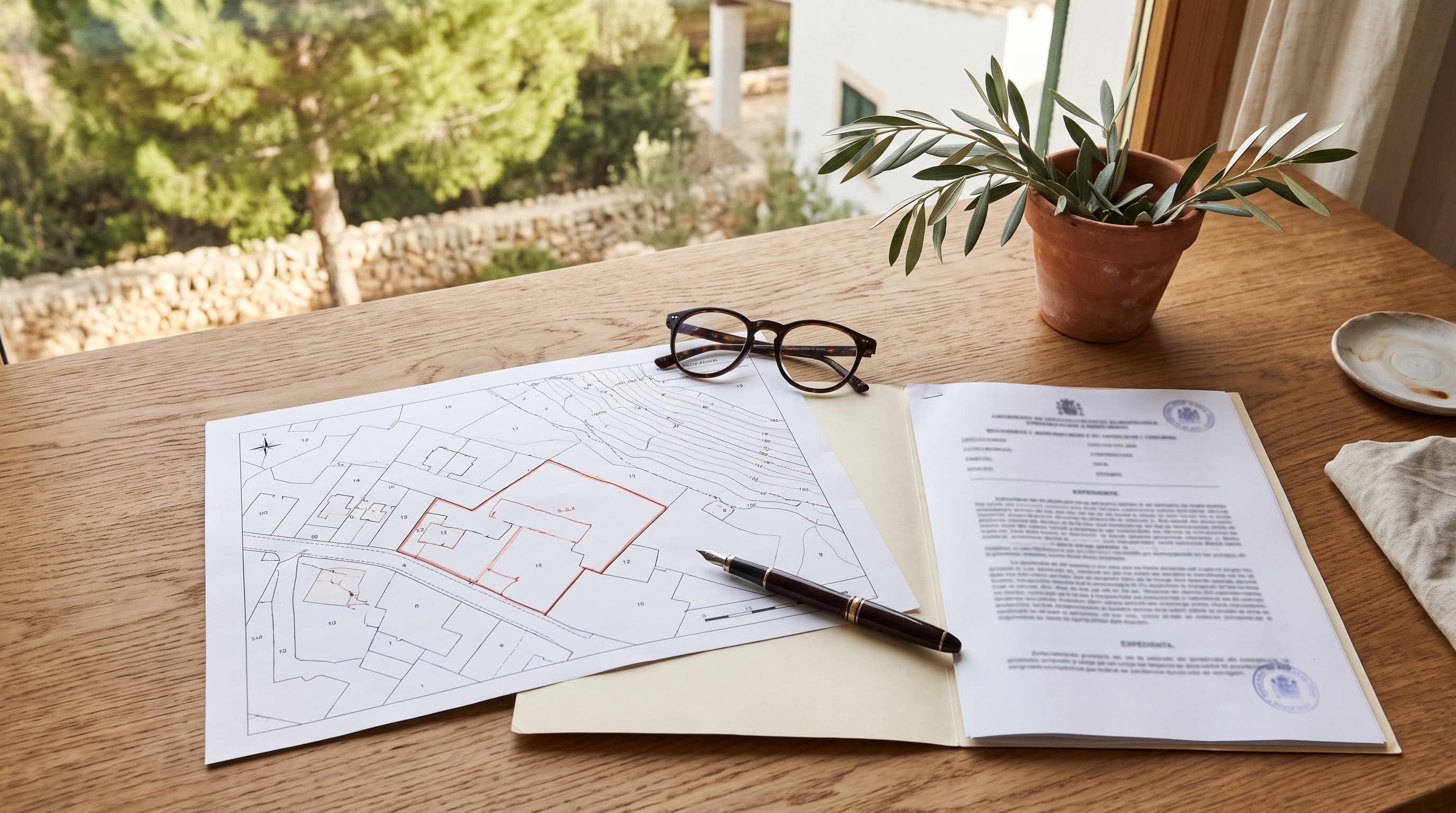
Ask for a recent nota simple and the referencia catastral at the start, not at the end. Look up the referencia on the Sede Electrónica and compare the plot area, the built area and the use with the description in the nota simple and the title deed. Check that the cadastral map shows the house where you expect it, with the pool and outbuildings you are paying for.
If the figures differ, ask the seller why and ask your lawyer to confirm how it affects the purchase. Write any agreed corrections into the private contract, with a clear deadline, before money changes hands.
For sellers, the same check is worth doing before listing. A home whose records match is simpler to value, simpler to finance and quicker to sell. If you are thinking about buying or selling in southwest Mallorca, browse our properties in Santa Ponsa and Nova Santa Ponsa or across Mallorca, call us on +34 971 692 434, message us on WhatsApp or email help@imperial-properties.com. To find out what your property is worth, use our free valuation form.
This article is general information and not legal advice. For a specific property, ask your lawyer to review both records before you commit.